


-
Art Tour NY | Bushwick Galleries, Summer 2016
di Matilde Soligno | A Walk Through The ArtJul 27, 2016
Even New York slows down during the Summer, with fewer and fewer art openings going on in the city. Even so, it is a good time to catch up with the Bushwick art scene, that has seen an increasing number of interesting projects being showcased in the area.
Luhring Augustine was the most established name to open, in 2012, a gallery location in the Bushwick neighborhood of Brooklyn. This Summer (through July 30) the gallery presents artwork from Jason Moran’s series: STAGED. The artist here uses an immersive installation (including sound) to render a historical view on a long-gone New York jazz scene, that is as faithful to the original as it is constructed, bringing the ambiguity of authenticity into the artwork.
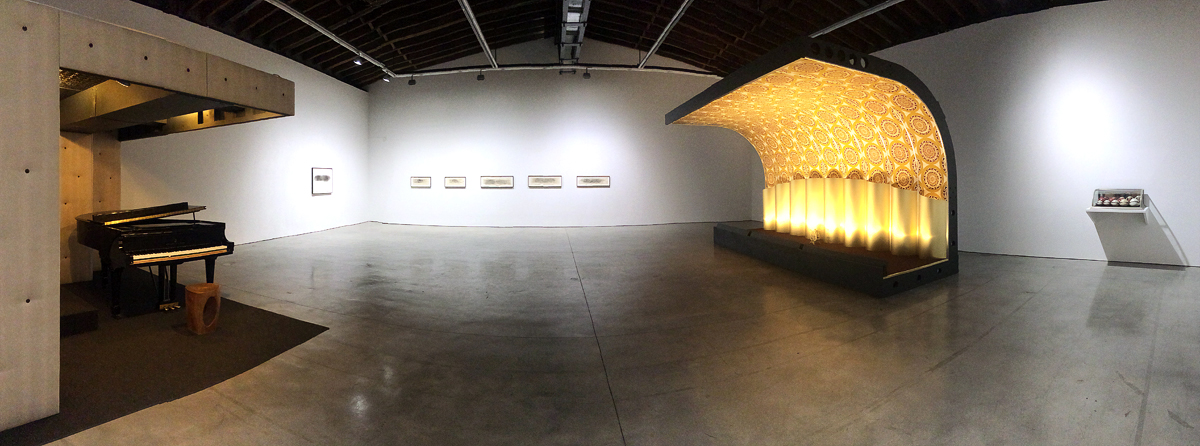
Jason Moran: STAGED at Luhring Augustine
through July 30CLEARING also moved its New York location to Bushwick in 2014, neighboring Luhring Augustine. Now the gallery is presenting – as many others during the Summer – a group show: Fritto Misto features artwork by Harold Ancart, Korakrit Arunanondchai, Huma Bhabha, Koenraad Dedobbeleer, Bruno Gironcoli, Marguerite Humeau, Zak Kitnick, Calvin Marcus, Marina Pinsky, and Lili Reynaud-Dewar (through August 14).

Left to right: Harold Ancart, Bruno Gironcoli, Huma Bhabha, Marina Pinsky
Fritto Misto: group show at CLEARING
through August 14Kurt Steger’s “floating” architectural construction Scribing the Void at ODETTA (through August 21) uses ‘soft’ materials such as wood to elicit in the visitor an experience of the union between something heavy and something light: matter and spirit. The installation also features an original music composition by RSM.
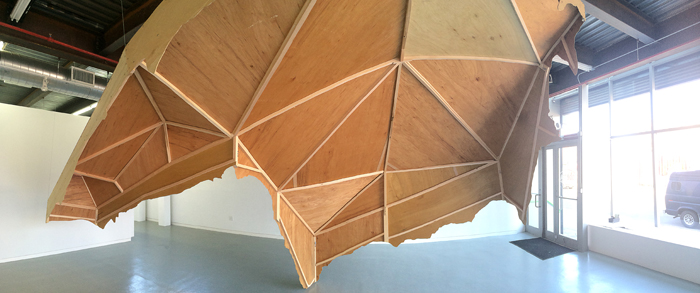
Kurt Steger: Scribing the Void at ODETTA
through August 21Interstate Projects’ U:L:O: is a curatorial invitational that invites 6 curators to present shows in one of three spaces: Upper, Lower, and Outside. Each show runs for three weeks and is in two parts. U:L:O: 2016 Part II (through July 31) includes: Al Bedell, Nichole Caruso, and Jupiter Woods. Notably, the big courtyard at the entrance is mostly taken by Corinna Helenelund’s Pony Play (2016), part of the section curated by Jupiter Woods. Helenelund’s playfully attractive installation echoes slightly suspicious in its tender and relaxed appearance.
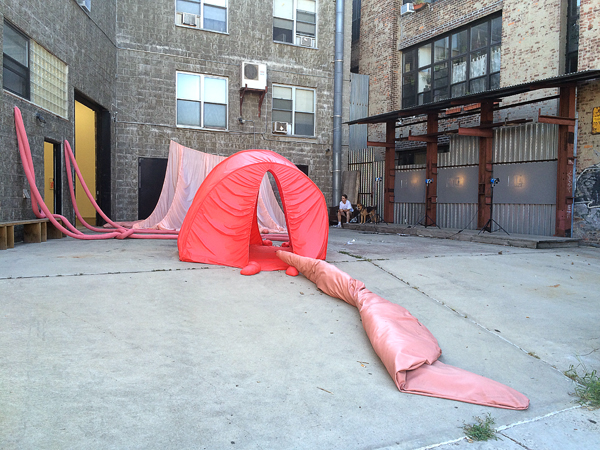
Corinna Helenelund: installation outside Interstate Projects
The group show Field Studies at TSA – Tiger Strikes Asteroid (through August 7) addresses exactly what its title suggests: experiments on the field, where science meets exploration and travel. These investigations often include impersonation, a journey inside subjectivity. Field Studies is curated by Andrew Prayzner and Naomi Reis, and presenting the work of Terry Adkins, Emilie Clark, Zachary Fabri, Rachel Frank, Matthew Jensen, Julia Oldham, and Lina Puerta.
Another group show, Rules of the Game at Transmitter (through August 7) sets its focus on the contrast between sport and art, where the first is essentially a set of rules in itself, while the latter is based on the crossing of boundaries and demystification of rules. The show features work by Palma Blank, Amanda Browder, Paul Corio, Jean Alexander Frater, Ben McNutt, Michael Namkung, Norm Paris, and Derrick Velasquez.
A fresh curiosity, Or Bust, a group exhibition at Honey Ramka (through August 14) gathers together a good number of contemporary sculpture in the relatively small gallery space. The artwork in the selection bears a clear reference to antiquity collections. The great variety of effigies reminds of ancient sculptures on museum displays, ranging from crafts to monumental.
-
-
Kurt Steger: Scribing the Void at ODETTA
through August 21
-
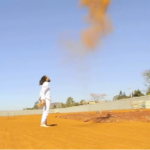
- Zachary Fabri (still from video) at Field Studies: group show at Tiger Strikes Asteroid through August 7
-

- Field Studies: group show at Tiger Strikes Asteroid through August 7
-
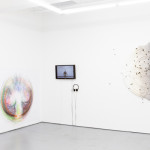
- Rules of the Game at Transmitter through August 7
-

- Or Bust: group exhibition at Honey Ramka through August 14
-

- Or Bust: group exhibition at Honey Ramka through August 14

-
-
Art Workers Italia | Manifesto
di Droste Effect | NewsMay 7, 2020

[ART WORKERS ITALIA], Art Workers Italia
The following manifesto was first published by Art Workers Italia on Labor Day, May 1st, 2020. You can learn how to be a part of the project at this link.
Who is Art Workers Italia [AWI]
[ART WORKERS ITALIA] is an informal, autonomous, and non-partisan group of contemporary art workers formed in response to the current crisis due to the COVID-19 pandemic.
AWI includes all figures who operate within public and private organisations and institutions for contemporary art – such as museums, foundations, cultural associations, universities, independent spaces, galleries – and/or those who carry out freelance work in collaboration with these organisations. Together, we have convened under AWI to communicate our demands with a single [INDEPENDENT VOICE].
We are [ART WORKERS]: artists, performers, curators, assistant curators, researchers, museum educators, art handlers, producers, lighting and sound technicians, registrars, videomakers, art critics, art writers, art historians, invigilators, couriers, gallery assistants, project managers, consultants, coordinators, conservators, graphic designers, illustrators, photographers, animators, studio assistants, communication and social media managers, and press office staff.
« Art Workers Italia »
The name « Art Workers Italia »[1] underlines our [LOCAL AND TRANSNATIONAL] perspectives: our analysis of working conditions is informed by the international community of contemporary art workers, while our understanding of workers and their needs is rooted in the historical and political context of Italy, in dialogue with other initiatives supporting [PRECARIOUS CULTURAL WORK].
Why was AWI founded?
[AWI] was founded in response to the social and economic [CRISIS] caused by the COVID-19 pandemic. For many of us, the crisis has resulted in the suspension and/or loss of jobs and projects. Furthermore, these selfsame employment arrangements have been the reason for exclusion, in most cases, from any form of social safety net or [PROTECTION] envisaged by the government in the “Cura Italia” decree, such as the cash supplement for unemployed workers or one-off bonus paid by INPS.
The criticality of the situation, amplified by the increase in demand for unpaid digital content during the quarantine by public and private entities, has clearly revealed several [STRUCTURAL PROBLEMS] of the sector. The majority of our work is [IRREGULAR] and [FRAGMENTED], defined by atypical and intermittent contracts, creating an [UNTENABLE] working situation. Furthermore, the lack of protective entities specific to our needs weakens the bargaining power at our disposal. Together with the fact that our wages often neither adequately compensate for the hours and quality of work done, nor the training and experience required, these conditions render our current working circumstances extremely [VULNERABLE].
All of this occurs in a sector in which wages barely above the poverty line coexist with the standards and regulations of the luxury goods industry, where an unacceptable percentage of unofficial and [UNAUTHORISED WORK] is simultaneously accompanied by high levels of education. It is in this context that, instead of monetary remuneration, alternative forms of “compensation” are imposed, with promises of exposure, networking, and building one’s reputation for the sake of a future (yet uncertain) position. This is supported by an [ELITIST SYSTEM][2] which complicity incentivises a dynamic of competition and [SELF-EXPLOITATION]. Ultimately, this situation undermines a healthy working environment based on respect for skills, training, experience, and collaboration.
What does AWI do?
[AWI] voices [MULTIPLE PERSPECTIVES AND NEEDS] through [COLLABORATIVE AND SELF-DIRECTED] inquiry, forming a critical mass and advocating for the inalienable right for the recognition of our status as workers, and along with it our subsequent rights and obligations. The organisation is divided into [COMMITTEES], according to different areas of focus, in order to articulate concrete proposals both in response to the ongoing emergency and in the long term.
[AWI] aims to define, develop, and provide operational [TOOLS] that provide support concerning ethical, political, legal and contractual nature. Our areas of focus include: strengthening and developing definitive measures of protection; studying the [SPECIFICITIES] of the non-profit sector; researching historical workers’ [STRUGGLES] in Italy; creating a comparative analysis of [GOOD PRACTICES] already tested in EU and non-EU countries; and identifying and coordinating with other national and international initiatives to protect [COGNITIVE LABOUR].
Ethical Principles of AWI
[AWI] upholds the principles of [INCLUSIVITY AND SUSTAINABILITY] as fundamental prerequisites of ethical conduct. We cannot, and we refuse, to discount the necessary solidarity with all workers who are underpaid and exploited. Furthermore, we strive towards a systemic change supporting an [EGALITARIAN FUTURE] for all [MARGINALISED IDENTITIES] in respect to gender, ethnicity, class, ability, sexual orientation, religion, age, and nationality.
AWI [IS NOT] an artistic or curatorial project – rather, it is a non-hierarchical and collective undertaking.Goals of AWI
Our strategic perspective, in the short and long term, is to focus on the [RECOGNITION] of the profession of contemporary art workers, the [REGULATION] of employment relationships, the [REDISTRIBUTION] of resources, and the reform and [RESTRUCTURING] of the entire sector.
Building upon previous efforts undertaken by others, Art Workers Italia is currently working in dialogue with several research institutions, universities, foundations, and cooperatives: to conduct [SURVEYS] designed to provide quantitative and qualitative information regarding contemporary art workers in Italy; provide training materials for professionals working within the sector; and develop a [CODE OF CONDUCT] specific to cultural work, that acknowledges its financial and value-extraction operations.
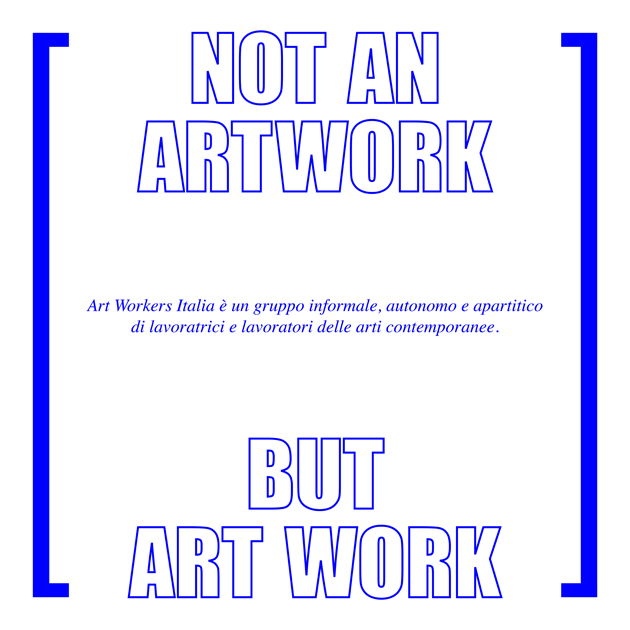
[ART WORKERS ITALIA], Not an Artwork but Art Work
COVID-19 Emergency Requests
Following requests already made by other social and cultural sectors, AWI asks the Italian government for:
• [BASIC ECONOMIC SUPPORT] corresponding to the gravity of the situation
• The extension of the measures already outlined in the Cura Italia decree to those who do not yet have a [SOCIAL SAFETY NET], a condition that affects the majority of the people who work in the sector, as they are subject to intermittent employment contracts or contingent work, and thus reach the minimum days of employment necessary with difficulty
• Confirmation of the appropriations provided by the Ministry for Cultural Heritage and Activities and Tourism regarding projects and events scheduled for 2020-2021 and, where necessary, the reallocation of funds for research and production activities
• Fiscal and tax relief, such as the extension of the 2019 tax balance for the current year; the suspension of advance payment under “Separate Management” for self-employed workers, whether as a lump sum or otherwise; the suspension of Synthetic Indices of Tax Reliability (ISA); and finally, the lessening of rents – through tax credit – for non-profit associations and other premises used for artistic production (including [ARTIST STUDIOS])
• A policy addressing the [COMPENSATION] of digital and online art productionLong-term Goals
Together with various institutions and entities, AWI will work towards the long-term goals concerning the following macro-themes: worker protection, the establishment of designated funds, and the reassessment of a system of increased competition and professionalisation. We aim to create an overarching organisation that can connect a constellation of individuals and associations, representing their collective needs and demands within the [PUBLIC SPHERE].
These include:• Developing a [PROFESSIONAL CHARTER] for those working in the contemporary arts, modelled after the Carta nazionale delle professioni museali
• Identifying key points in the current legislation applicable to contractual [EMPLOYEE] positions; developing legal forms that more accurately reflect current working situations, with the intent of proposing one or more drafts for future models of national contracts relevant to the different roles within the field of contemporary art
• Creating new ATECO codes, or revising pre-existing ATECO codes, for [INDEPENDENT CONTRACTORS] to adequately address more specific needs and extend to them legal protection such as unemployment benefits, sick leave, maternity leave, and parental leave
• Proposing [FAIR COMPENSATION] for services rendered by artists and arts professionals (such as exhibitions, performances, public conferences, workshops, screenings, reproductions for commercial and non-commercial use, exhibition installation, curation, etc.), in addition to promoting and monitoring the widespread use of these standards
• Requesting the Italian government to adhere by guidelines such as the Statuto sociale degli artisti – Risoluzione del Parlamento europeo del 7 giugno 2007 sullo statuto sociale degli artisti (2006/2249(INI)) and their subsequent updates that take into consideration existing industry needs
• Enabling access to [DESIGNATED FUNDS] in Europe dedicated to the production and acquisition of artworks, artistic training, and professional research and development, to be available regionally and nationally
• Proposing the establishment of a [FUND FOR VISUAL ARTISTS] by expanding upon the pre-existing INPS PSMSAD Artist Fund
• Calling for funding to be more transparent, inclusive, and reflective of current practices of cultural production, as well as arts education, by restructuring the current [SYSTEM OF OPEN CALLS AND GRANTS]. To this end, we ask for public funding to be conditional upon the fair remuneration of all the artists and professionals involved
• Expanding the number of entities and activities who can benefit from [PATRONAGE] – such as Art Bonus – and provide additional tax breaks for donations made to support contemporary art
• Facilitating [SPONSORSHIP] in contemporary art by bridging the information gap between possible sponsors and sponsees
• Promoting [PROFESSIONAL DEVELOPMENT] for artists, [ARTISTIC STUDIES], and the role of education in contemporary art in the education system in ItalyConclusion
Contemporary art workers operate at all levels of national and international cultural production, in both breadth and depth. Collectively, the sector does not only impact the [SOCIAL COHESION] of a community but also its [INTELLECTUAL AND CIVIC GROWTH], carrying significant economic repercussions across the country.
This manifesto[3] represents the first step away from an unjustifiable and unacceptable condition of [INVISIBILITY], towards the goal of full civil and political recognition that takes into account the fundamental role, and its specificities, that contemporary art professionals occupy within the larger sphere of local and global cultural production.
[1] The reference to the historical group Art Workers Coalition (1969) did not influence our decision to name ourselves Art Workers Italia, but is certainly part of the cultural references shared by the group.
[2] The possibilities of professional success in the field of contemporary art are often directly proportional to the capital available at one’s outset. Because this capital can also be social or cultural in addition to being an economic one, we have chosen to use the term “elitist” instead of “classist.”
[3] The manifesto and agenda presented by AWI are to be considered exclusively political tools. Arising directly in response to the urgency that led to the spontaneous establishment of the group, this manifesto represents the main tool for conveying this energy across multiple public contexts such as the virtual march on the occasion of Primo Maggio Cittadino in Turin, 2020, during which the foundation of AWI was first publicly announced.
-
Bulletin #20. FIBERS by Renata Zas
di Droste Effect | Bulletin, FeaturedJul 24, 2019

Bulletin #20
FIBERS. Voice, skin and earthby Renata Zas
Abstract:
This paper is aimed to invoke a different direction to the crisis that digital life and the Anthropocene are forcing us to face as humanity: instead of a speculative imagination about egress, it will propose an intense recuperation of the potency of our sense of being nature, an extension of Earth, in our most immediate present. The shift that Western theory is making in order to think of an alternative to the irreversible damage we have provoked is to imagine a world-without-us. Would it be possible to imagine ways to avoid leaving our bodies, and instead to think, live, feel and process through them?
About the author:
Renata Zas (Buenos Aires, 1990) is an art researcher and curator based in Buenos Aires and other places. Between 2003 and 2008, she completed her secondary studies at Escuela Superior de Comercio Carlos Pellegrini, University of Buenos Aires. In 2009, she started contemporary art and management studies at ESEADE – Instituto Filadelfia (Buenos Aires). She was fellow of the Artists’ Program at Torcuato Di Tella’s University Art Department (Buenos Aires, 2015) and of Art and the Poetics of Praxis in Cognitive Capitalism at Saas Fee Summer School (Berlin, 2018). She also holds an MA in Contemporary Art Theory from Goldsmiths University (London, 2017). Renata has recently received the scholarship BECAR Fondo Nacional de las Artes (Argentina) to travel to Italy for a month on a field research trip (2018). She is interested in horizontal practice as a work methodology and is currently researching the last and ever-expanding technological revolution whose effects are sensed both in human sensitivity and empathy. Renata has worked in Buenos Aires as assistant curator; coordinator, producer and programmer of artistic workshops for Centro Cultural Kirchner; assistant for contemporary art galleries, art editorials and art residencies. She also assisted artists and curators in different projects. Renata’s practice is influenced by curator and writer Rafael Cippolini, philosopher and media theorist Franco «Bifo» Berardi, and therapist Daiana Dominguez, among many others.
-
Artissima Live – Interview with Marco Scotini
di Vincenzo Estremo | Focus on EuropeNov 26, 2018
Following the experience at #ArtissimaLive, Droste Effect is publishing the interviews collected during Artissima 2018 in Turin; find all articles at #ArtissimaLive.
Second conversation: curator Marco Scotini on artist Zheng Bo
Marco Scotini is Artistic Director of the FM Center for Contemporary Art in Milan. Since 2004, he is Head of the Visual Arts and Curatorial Studies Department at NABA, Milan. Since 2014 he is Head of Exhibitions Program at PAV – Parco d’Arte Vivente, Turin. On November 3rd, 2018 Scotini opened the first Italian solo exhibition of the Chinese artist Zheng Bo, Il Partito delle Erbacce / Weed Party III.
On November 2nd we met Marco Scotini at the #ArtissimaLive booth and this is our conversation.

Zheng Bo, Socialism Good, Photographic print (2018) of Socialism Good, 2016. Alternanthera, soil, weeds, 400 x 1600 cm. Commissioned by CASS Sculpture Foundation, UK. Courtesy the artist.
VINCENZO ESTREMO – Zheng Bo is an attentive investigator of the relationship between plants, society, and politics. He is one of the most interesting Chinese artists of the younger generation. Lately, he was among the participating artists at Manifesta 12 in Palermo; he has recently exhibited at the second Yinchuan Biennale, and he is also involved in the 11th Taipei Biennial curate by Mali Wu & Francesco Manacorda. Could you tell us how and why you decided to bring Zheng Bo at PAV? And, in which way his work may be associated with your curatorial activity at the Parco d’Arte Vivente?
MARCO SCOTINI – I had the chance to get to know Zheng Bo’s work better this summer, because he was one of the participants in the Yinchuan Biennial that I curated. It was then that I discovered the activity of Zheng Bo, and his research in the field of ecology in Southeast Asia. For that biennial, Zheng Bo planted about 400 poplar plants in which a slogan of socialism could be read on the ground. Thanks to “Propaganda Botanica”, Zheng Bo makes use of historic Marxist slogans recreating them by using plants in order to expand notions such as “equality”, “workers” or “socialism” beyond the human sphere. In that specific case, the slogan, “Earth Workers Unite”, left open the possibility of a two-fold interpretation: not so much that it is the workers of Planet Earth who are uniting (according to the orthodox version), but more that an association against common exploitation should become possible between the Earth and its workers. Considering this precedent and considering the activity that since 2014 I am carrying on at the PAV, started with the exhibition Vegetation as a political agent, I thought it might be interesting to inaugurate the new exhibition season with Zheng Bo. This won’t be the only exhibition concerning the field of ecology in Asia. The PAV is continuously committed to carrying out a program dedicated to that art scene. In April we will inaugurate an exhibition by the Indian artist Ravi Agarwal and after that, we are willing to develop the theme of ecofeminism with investigations focused on South East Asia.
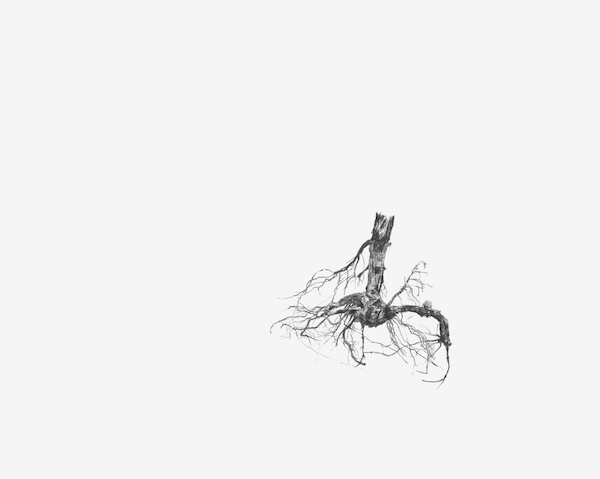
Zheng Bo, Grass Roots, Pencil on paper, a set of 12 drawings, 27 x 34 cm each, 2015. Courtesy the artist.
VE – What about the exhibition Il Partito delle Erbacce / Weed Party III? Could you tell us something about this project?
MARCO SCOTINI – Regarding this exhibition, the idea was to present Zheng Bo’s research and then return in the spring with a permanent action located within the context of the PAV’s park. This exhibition is articulated through 4 types of work. In the first room, there is a huge photographic reproduction of an installation composed of plants and flowers quoting the slogan “Socialism is Good,” and located in Tiananmen Square from 1991. With this action, Zheng Bo focuses on an intervention that is presented as political propaganda, but at the same time is destined to deteriorate over time to let forms of spontaneous vegetation emerge within the decorative aspects of text patterns. These slogans are destined to be altered by forces from below due to Grassroots actions. Thus, Zheng Bo confronts the rhetorical capability of these slogans. In the greenhouse, there is a sort of garden. The work “After Science Garden” (2018) is the second version of the garden built in Minneapolis one year ago. For the realization of this work, the artist consulted a botanist from Turin, who advised him on a number of spontaneous plants that grow in the city. It is not a permanent project, it is an indoor cultivation, and it may be better defined as a path among plants. LED lights hanging over the plants help them to grow.

Zheng Bo, After Science Garden, Site-specific installation (plant, led lights), variable dimensions, 2018. Courtesy the artist.

Zheng Bo, After Science Garden, Site-specific installation (plant, led lights), variable dimensions, 2018. Courtesy the artist.
The insistence of Zheng Bo on weeds is to be framed within the close relationship between the plants and the anthropic ecosystems. The artist often intervened by activating forms of spontaneous activity in the plants in order to facilitate the ability of plants to occupy spaces. Zheng Bo reflects on the fact that when there is free space – when an architectural artifact is destroyed – plants can and do fill that context with their presence, occupying the empty space. Within this garden are installed the pages of two volumes that Zheng Bo found. One related to 1945 and another to 1961. The artist has manually rewritten these two survival manuals that have to do with the food function of the weeds. The 1945 manual is Taiwanese, and it connected to the Japanese occupation of the country, a period when people were advised to feed on weeds in order to survive. The one from 1961 refers to a great famine in China and to the years when people who suffered from hunger were suggested to eat weeds. The collection of drawings “Grass Roots” (2015) treats the Grassroots political phenomenon. These analytical drawings of weeds’ roots are linked to the phenomenon of emancipation movements from the bottom. The series deals with the centrifugal forces of unrecognized classes, and aims to promote forms of alternative politics. Obviously, these political movements are absolutely banned in China. Zheng Bo tried, while working in Italy, to be in touch with the NO TAV movement here in Piedmont, due to the interest of this movement in preserving the ecosystem from huge infrastructural work. Last but not least, the exhibition includes 2 of the videos from the Pteridophilia cycle.

Pteridophilia 2, video (4K, color, sound), 20′, 2018. Courtesy the artist.

Pteridophilia 1, video (4K, color, sound), 17′, 2016. Courtesy the artist.
These videos, that are set in fern forests in Taiwan, show young people having sex with the plants. In the first video, a number of young naked Chinese have sex with ferns, in the second there is only one young man having sex with ferns of a different nature. The intercourse ends up with the guy devouring the plant.
As you may know, the fern is an asexual plant that does not produce seeds or flowers. The sexual apparatus of this plant – the reproductive system – is hidden, thus it does not live by canonical sexual procedures. What interests Zheng Bo is not to produce plant pornography, but to make people perceive that the plant is an active organism. The union between man and nature reflects on the forms of socialism and on the reasons of its failure. In fact, Zheng Bo disputes the separatist version of the relationship between man and nature, man and the environment. An element which is not typical of the Asian tradition, in which there is a strict coincidence between man and nature. A relationship destroyed only by the modernist plans of Mao Tse Tung. The reflection on the socialist apparatus and on the absence of the environmental element is a response to the collapse of nature. Ultimately, the work of Zheng Bo is not limited to framing the Anthropocene, but is committed to bringing attention to contextual micro-political actions.
-
Artissima Live – Interview with The Cool Couple
di Droste Effect | Focus on EuropeNov 19, 2018
Following the experience at #ArtissimaLive, Droste Effect is publishing the interviews collected during Artissima 2018 in Turin; find all articles at #ArtissimaLive.
First conversation: artist duo The Cool Couple
The Cool Couple is an artist duo established in late 2012 by Niccolò Benetton (1986) and Simone Santilli (1987) and based in Milan, Italy. Their research focuses on the friction points generated daily in the relationship between people and images. They usually start from micro-themes, specific cases, that become a metaphor for dealing with a whole series of problems. The Cool Couple, represented by MLZ Art Dep gallery, is interested in the relationship with the users of the work of art and all the relationships between the figures within the art system that they believe are essential elements of the artistic practice of all the artists.
On November 2nd we met Niccolò and Simone at the #ArtissimaLive booth and this is our conversation.

The Cool Couple, Emozioni Mondiali, Futuristi vs. Postinternet, 2018, video still, inkjet print on fine art paper, Diasec®, woodframe, 65x100cm
VINCENZO ESTREMO – I would like to talk with you about filters for experiencing an artwork: that of the fair in particular. How well do you think a work can be presented within a “walking” context like that of an art fair – and to what extent do you think your work, in terms of proposal and approach, can succeed in doing so, by stopping, somehow, these quick walks from booth to booth?
THE COOL COUPLE – Inevitably, the work we exhibit here at the fair, Emozioni Mondiali, requires a particular approach to the display, as it is a game station. The stand of our gallery has also been placed in a particular position, near the sofas, so the public not only passes but people also sit down and relax. We are in the heart of the Present Future section.
The installation and the work itself also have an interactive element, thanks to an extremely common device: console and seats. In fact, it there is often a willingness to know more about Emozioni Mondiali by those who approach the stand. Even if paradoxically, in a collateral way, there is always a way to deepen the experience of it. Beyond the “normal” questions of the adult visitors, at some point, the children playing started to ask who the players were. When you work there are things that remain on the sidelines of the research and you know “this could happen”, but it is only when the work is installed and people interact with it that it really happens.VE – A way to understand art, almost a quick and short kind of educational process starting from an unusual medium.
THE CC – Well, the works are not really thought as didactics. But they certainly arouse interest. It’s a bit like what happened with Karma Fails. Similarly, here you rely on experiences that are commonly lived outside the context of art. And, through that paradoxically reflective moment, we, as an artist, can actually “hook” you. It’s the trigger that makes the whole project work. This could mean everything, and it doesn’t mean anything in the end. You cannot really produce a statistic and say how much this thing is working or not.
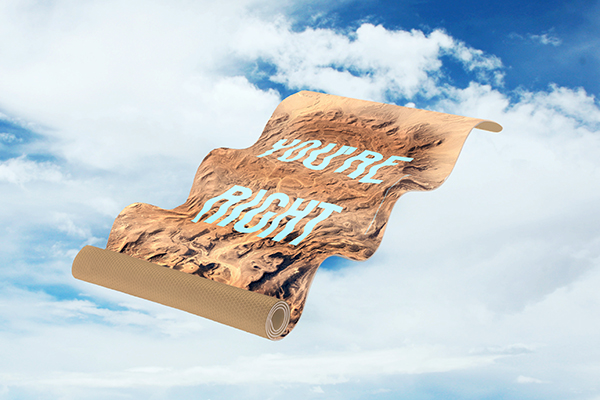
The Cool Couple, Karma Fails, Flying Mat®, Silence (render), 2016
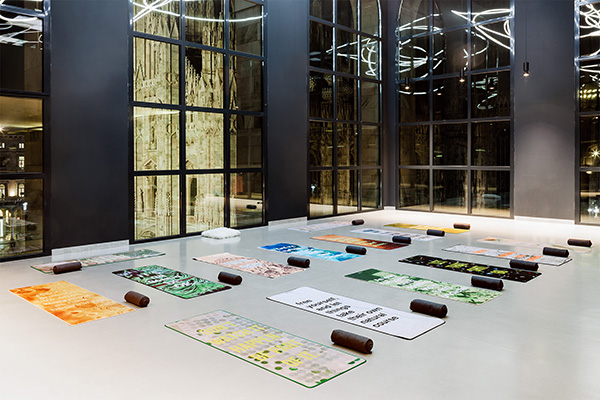
The Cool Couple, Karma Fails, installation view, Museo del Novecento, Milan, November 2017
VE – I have a question as a football enthusiast. What is the relationship between art and games, and the ability of events to take you to other conditions of reality? Through video games, attention is carried away from reality…
THE CC – The videogame is not only the formalization, but the integral part of Emozioni Mondiali. In our opinion, it was interesting to relate the world of gaming and the world of art for three reasons: because there are extremely similar dynamics – self-promotion, for instance: there is an individual who makes an investment on him or herself as if they were their own company, but there is also the whole question of competition and promotion. These topics are present in many areas of the project. And then, there is a whole series of references that touch a very delicate issue that is perhaps one of the biggest obstacles in the fruition of this work. On the one hand, it is a unique experience and, on the other, it has to do with football which, according to a certain stereotyped approach, is the emblem and foundation of pawns, completely passive, that are part of a system of entertainment that elevates and involves them, but that in the end does not provide any chance of emancipation. There was an emblematic case two years ago when Patrick Thistle F.C., a team in the Scottish League, commissioned artist David Shringley to design their new mascotte: Kingsley was an ugly little star man who caused quite a scandal. He scared the children. His head was so big that he couldn’t even wear the team shirt. There was a collision between the world of art and football and many journalists began to write about this mascotte. It was perhaps a symptom of the long wave of strong theories that still see society rigidly structured into cultural taxonomies and hierarchies. We live in a world that is claiming for freedom of expression, but in reality, we are constantly exposed to a very strict compartmentation of society. The figure of the artist is successful just when his practice produces strong frictions in the public – in an environment like football, Kingsley was intended as one of those operations, because of the negative and perplexed reaction in Patrick Thistle’s supporters, while, in reality, Shrigley himself gave a completely different motivation to his work.
For us, it’s extremely interesting, because if there is one thing that’s true, it is that the art system and the world of male association football share very similar dynamics. If you are a football enthusiast in some way you follow the game and you are also aware of the languages that develop within this world: the recognition of a certain football style, the dynamics of the game… the same for art lovers who enter a museum and recognize style and technique of works. In the field of visual culture, only recently attention has been driven to these kinds of dynamics. There’s a new awareness rising, involving the fact that the influence of old theories and prejudices about sports, in general, are still strong.
Today, videogames and football go hand in hand. They move a lot of money and the football professional players themselves play the video game. They even study their opponents’ moves through the simulation provided by it. There are even teams like Paris Saint Germain that hire gamers to use their team in PES’s official competition, dialoguing with them to understand how to improve the performance of the team.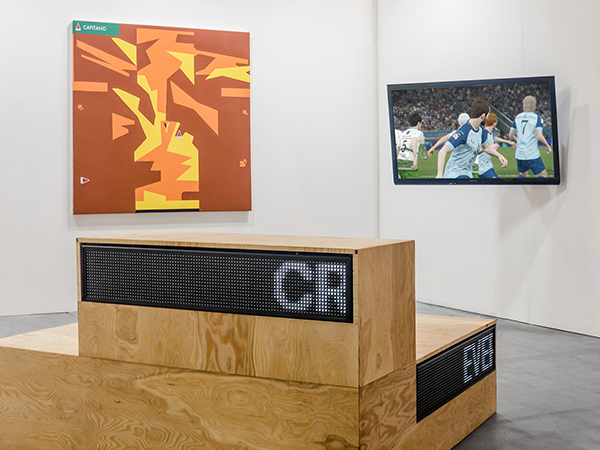
The Cool Couple, Emozioni Mondiali, installation view at MLZ Art Dep gallery, Artissima 2018
VE – Teams are starting to work with professional video-game players, also to improve the predictions of winning on a statistical level. The gamers are able to update the statistics that are taken during a match in order to improve the patterns of play etc. The data analysis in football works a lot. The video game becomes the perfect synthesis for which this connection between reality experienced and reality built or virtual is revealed.
I would now like to ask you this other question about the other works that you have produced and brought to the fair (paintings). They even seem close to the aesthetics of some 90’s soccer jerseys. For example, recently Napoli football team has chosen to propose a uniform that went in 1994. In your stand, there is a repetition of all these cycles and recycles and repetitions of visual and aesthetic.
THE CC – Yes, then trying to make it short, the premise is that our customization process is entirely based on PES2018 editing options featured in the game. The developers have always left this possibility to the gamers, so the latter could overcome the fact that every edition of the videogame didn’t feature many original teams, replacing them with fake ones. Players worldwide collaborate to build the kits in order to let everyone use official names, jerseys, and so on. In recent years, the jerseys’ design relied on jpegs that can be made in Photoshop, increasing exponentially the quality and details of each jersey. You just have to download a square empty layout, open it in Photoshop and then start drawing. This process allows you to reproduce almost everything, like, let’s say, Atalanta’s 1990’s jerseys. The only thing is that the layout you work with requires a bit of understanding because it is a square divided into areas that are meant for the console: it reads them and models those flat areas in 3D meshes. So, the big part of this work was understanding how the layout worked and then conceiving styles and graphic designs for all the teams we wanted to create: the criteria we chose were quite different, trying to combine sportswear styles, a movement’s philosophy, sometimes quoting artworks… Within the limits of what we could do, we tried to respect certain criteria such as chronological ones. Since outside the console, these things exist as abstract patterns that have no relevance to a football uniform, we realized that in the end, we had produced more or less eighty abstract images. At that point, it became obvious to think about the great presence of stereotypes existing in the world of art. The results are hand-painted canvases now on display at the fair. Painting is perhaps the most obvious language quoted when one thinks of art, both at an amateur and professional lever. In addition to this, painting had a strong relation to the chronological period we decided to include in Emozioni Mondiali, since we start from the Renaissance and Mannerism, not only the moment in which art history as a discipline was created, but also the period in which the combination of oil painting and canvas made it capable of traveling. We relied on Chinese websites to which you can send images and they turn them into a painting: as we browsed through the various options on the site, our squares fell into the section of what they called “abstract landscape”. Finally, it has a lot to do with the football world. As if we were two sportswear designers, we drew our jerseys and then delocalized the production. The stills from the videogame also on show at the fair rely instead on all the options available in PES replays, and in videogames in general, that turn you into a videomaker or a photographer. It was useful to bring out a first reflection on the visual dialogue between art and football.
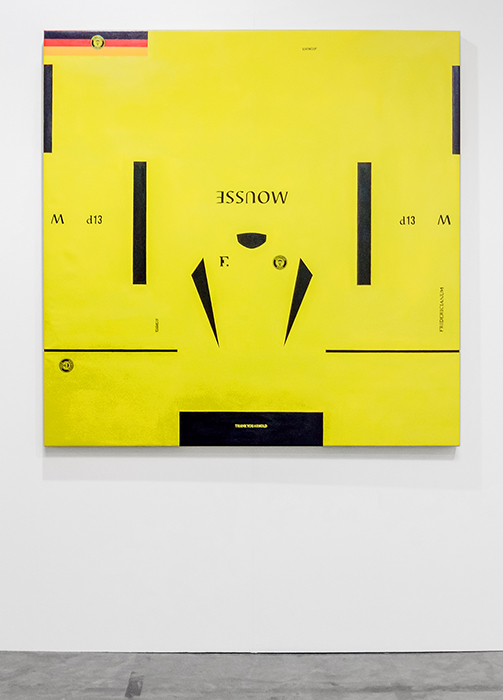
The Cool Couple, Emozioni Mondiali, Documenta HOME, 2018, household gloss on canvas, 145×145 cm
VE – Another artistic work comes to mind with reference to the world of football, that is the portrait that Parreno makes of Zidane: in this modern portrait the relationship between art history and football, or rather the mediatics of football and how football is presented, is also recalled. Clearly there are also many references to cultural studies and scenography. Let’s talk about the way in which you decided to present this work that reminds much of the domestic and familiar context. Not by chance, the ones that approach your stand are many young boys who are going to play with the console.
THE CC – The installation could be seen as a place of abstraction and distraction of the context in which it is exposed through the act of playing. Even at Mambo, where Emozioni Mondiali was presented for the first time, people were taken so out of the context of the museum that they let go of themselves using a language that is much more direct and sincere than what you can have at an exhibition opening. So, for example, sentences like “The Futurists are shit!”… In an exhibition or so you would never say this, but while playing videogames it happens that you simply let go.
VE – The very amusing thing is the overlapping between the football perspective on the game and the artistic one. You can hear phrases that derive from this inevitable overlap between the figure of the artist and the player, such as “Oh god, Boccioni is so slow!”.
THE CC – There is an impressive liberation of language. Even in art, there are unwritten rules of “bon ton”. For instance, I have opinions, but I feel like I can only express them in a hyper-private context, because even among friends you do not know how much you are in a working context and how much instead you are relaxed and can express your own thoughts. Actually, with a joystick in your hand and your eyes locked to the screen, you are driven by an emphasis that produces comments “out of place”. It’s a beautiful moment because it really breaks up and contrasts with the typical situation of an art fruition, where we are used to wandering around with sheets of paper in hand and pre-packaged texts. Perhaps the world of art is the one that has most of all abandoned the critical aspect and is something we often talk about.

The Cool Couple, Emozioni Mondiali, installation view at MLZ Art Dep gallery, Artissima 2018
VE – We’ve raised an interesting point, so I would like to compare it to criticism in the world of cinema. In cinema, for example, there is an important tradition of critical figures who then become hybrids, because they become creative actors themselves, or directors, screenwriters, etc. It has been argued that, in the art world, this has been lost: the art critics paradoxically move away from those who make art, moving more and more towards the production of content without content. This lack of knowledge could even lead to inaccurate criticisms, because they are superficial, in the sense that they do not stop to know the whole process behind an artistic creation. For example, your work could be branded as “easy” because it comes with a very attractive interface, an effective contemporary aesthetic, but criticism eventually breaks away from these kinds of things… Now, you have already been involved in other talks at the fair, and we would like to know what you think of these live events, and how much do you think this aspect that we could call performative can enrich and invite the public of professionals and amateurs to approach the world of contemporary art?
NICCOLÒ – So, I personally say no and I am not a big fan of talks. I got a little disillusioned over time. Attending several talks I always had the impression that they ended up always a bit suspended. Partly because of the shyness of the audience to approach the speakers, partly because sometimes some speakers even do not attend being very well prepared, so you never really get to delve into it. But I think that this lack stems precisely from the approach with a “mixed audience”: that is, for amateurs talks can be the field of new discoveries, but for professionals they can become extremely superficial.
SIMONE – In my opinion the experience of the fair is intense already in itself, because there is always a lot to see and do so talks often find the time they leave. Instead, I find that this dimension (Artissima Live) – where we are actually not doing a talk, we are talking to each other – it could be very interesting. A streaming or podcast production would allow both a live use from those who are visiting the fair or are working or can’t come to Turin, and it could also be an audio archive of materials that can lately be accessed by the public. In fact, it would be especially interesting for professionals who are involved in the exhibition context and perhaps engaged in other areas and who would like to meet and deepen certain topics. Because certainly an interesting point of the fairs is the fact that you can have the opportunity to interact with international professionals from the art world who for a few days are sharing the same spaces together.
VE – More than the talk itself, the interesting aspect is the performing one. As we said before, and in connection with your work, you never expected that the children playing would then ask questions about the history of art collaterally from the names of the teams and players. There is also this sort of update of the various worlds of art and contemporary art. It is very interesting to find these aspects of dialogue and deepening in situations that we could call performative, where the public is involved even more directly, and where the hierarchical scale or sector is completely destroyed. In the end, we must take advantage of these opportunities for spatial, temporal and also social concentration, not so much perhaps for an in-depth study that will certainly take place afterwards, but for an effective circulation of new ways of communicating and approaching.
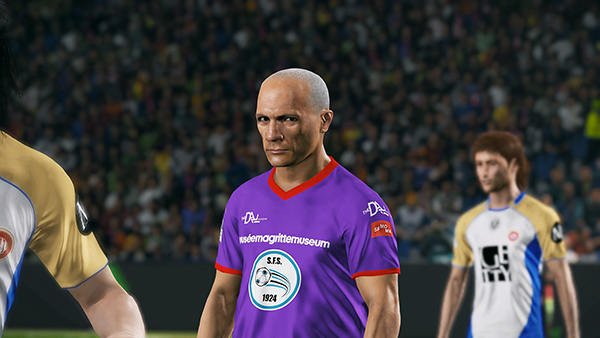
The Cool Couple, Emozioni Mondiali, Picasso, 2018, video still, inkjet print on fine art paper, Diasec®, woodframe, 65x100cm
-
Bulletin #15 – Art & Automation: for an apologia of leisure time
di Droste Effect | BulletinSep 21, 2018

Droste Effect presents Bulletin: non academic art papers
Link to free publication:
Bulletin #15. art & automation: for an apologia of leisure time by Marco AntelmiRobotics and soft AI are bringing everyday changes both to the work field and to our free time. How does this condition reflect itself on the artistic practice? Can we humans liberate ourselves from our anthropocentric viewpoint and accept the intellective superiority of machines? Will we be able to overcome our fear of automation? In the utopian view of a fully automated production, not only work ethics should be re-thought, but also our certainties about aesthetics.
About the author:
Following his post-internet experience, made of memes and experimental techno music, Marco Antelmi (Bari, IT, 1993) analyzes the new accelerationist theories. From this moment, his world opens up on the analysis of anthropocentrism and focuses on the ecological issue and on the relationship with alterity, enquired in his artistic research.
Graduated in Civil Engineering at Politecnico di Milano, he is now attending a MA in Visual Arts and Curatorial Studies at NABA – Nuova Accademia di Belle Arti in Milan.
-
Bulletin #9 – Media Art and the Art Market. What’s going on?
di Droste Effect | BulletinMar 30, 2017

Droste Effect presents Bulletin: non academic art papers
Link to free publication:
Bulletin #9. Media Art and the Art Market: What’s going on? by Alessio ChiericoAbstract:
Media Art is a controversial term that identifies manifold artistic experimentations that refer to the use of media technologies as objects and/or as a subject of investigation. The larger part of this field developed independently from the usual art circuits, proliferating in contexts like festivals, research centers, academic institutions, but also on the Internet, through communities, mailing lists, and social networks. The classical institutions of art have for a long time now recognized and hosted some of the emerging forms that traditionally belong to Media Art, however, they also demonstrated suspicion and distance which limited the possible integration and understanding between the two sectors. In recent years, new generations of digital native artists, who grew up in an established technological environment, use the imageries and topics of Media Art within the languages of contemporary art, prefiguring forms of merging between these two worlds. This process becomes evident when Media Art starts to question its position and its possibilities to enter the art market, which is one of the main routes to its legitimization into the mainstream art world and to its historicization. This text is a report of the Media Art and Art Market symposium in Linz, Austria, which aimed to address the current status and problems of the market of Media Art, particularly the compatibility of this sector with the general understanding of the art system.About the author:
Alessio Chierico is an artist and researcher with theoretical background in contemporary art, design theory, and media studies. He is currently a PhD candidate at the Interface Culture department of Kunstuniversität Linz (AT), and graduated in the same university. Chierico has been a visiting student at IAMAS Institute of Advanced Media Art and Sciences in Ogaki (JP), and is a former student of NABA in Milan and of the Art Academies of Carrara and Urbino (IT). In the last ten years of activity, he had more than sixty exhibitions, including: NTAA/Update (Ghent, BE) Flux Factory (New York, US), MAXXI (Rome, IT), Darbast Platform (Tehran, IR), Centro Luigi Pecci (Prato, IT), Roma Media Art Festival, Villa Manin (Udine, IT), ArteLaguna Prize (Venice, IT), Ars Electronica Festival (Linz, AT), Museu Nacional de Arte Contemporânea (Lisbon, PT), Victoria Art Gallery (Bucharest, RO), MAMbo (Bologna, IT), Speculum Artium (Trbovlje, SI). He regularly contributes with conferences, talks, and academic publications. In 2014, he was the recipient of the Lab Award (Augsburg, GER), and in 2008 he won Milano in Digitale (Milan, IT).
-
“to Disconfirm” the narratives of history and identity at galleria+
di Droste Effect | NewsApr 22, 2015
«Not in the subject of the picture or in the technique of the painter is the difficulty of the puzzle, but in the wisdom of the cut, and a random cut will necessarily produce an uncertain difficulty, oscillating between an incredible ease for the edges, the details, the light stains, the well-defined objects, the brush strokes, the transitions, and an annoying difficulty for the rest: the cloudless sky, the sand, the meadows, the cultivated fields, the gray areas.»
G. Perec, Life. A User’s Manual
Within the context of different narratives of the past, the formation of an identity (or identities) has represented a control instrument as well as an object to be defined and redefined. to Disconfirm highlights the ways to deny and to tell the stories about this plurality of identities. to Disconfirm is an attempt to use visual art for questioning the plural identities buried under the weight of historiographical institutions.
In recent years, the narratives that helped to create what we call “history” have been enriched with a number of short stories. Identity has become something that can be said in time (measure), an historical object that can be related to a geography (location).
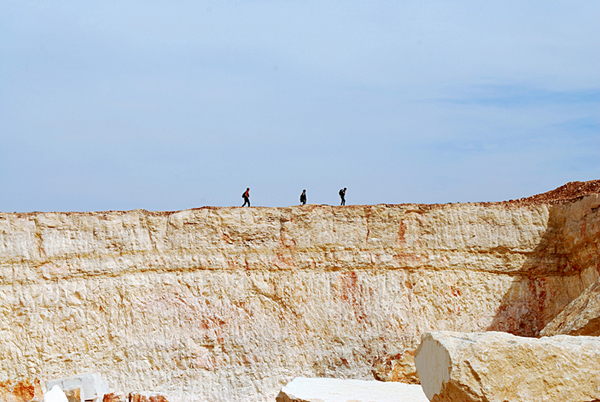
Matteo Guidi, Giuliana Racco, In Between Camps photo series, 2013
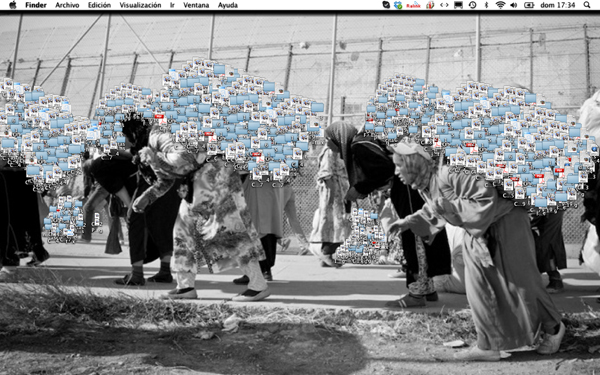
César Escudero Andaluz, File_Món. 2012_Captura de pantalla 2013-11-30 a las 18 40 54
Nowadays visual art has acquired functions and properties of contemporary narratives in order to have at its disposal cultural tools able to produce and to develop an adequate analysis of history and identity. Art rewrites pieces of history and re-questions commonly accepted assumptions related to identity, but above all its function is to deny what has been already taken for granted. When Perec chooses to tell about the difficulties of the painter, or rather the artist, in defining the instructions-for-use puzzle, he does it by starting from a denial. Within the network of narratives, artists look for the possibility to deny – they implement the action to Disconfirm – through their attitude and their perseverance. Here we go back to Perec and to determination, with which Barnabooth chooses to carry on his arbitrary life plan. While apparently useful only to the project itself, his plan makes us understand how artistic research is something unnecessarily indispensable. In its uselessness lies the gift of denial, the gift of fragmentation, which often is the set of practices that enable artists to corrode everything that apparently seems unique and indivisible, as the granite imaginary of history and identity.
to Disconfirm will be an opportunity to shape different researches and to make them coexist: studies on interfaces by César Escudero Andaluz, critical documentary film practices by Matteo Guidi, Giuliana Racco and Amanda Gutiérrez, and installative works by Massimo Ricciardo.
César Escudero Andaluz, Matteo Guidi, Giuliana Racco, Amanda Gutiérrez, Massimo Ricciardo, to Disconfirm, curated by Vincenzo Estremo at galleria+, Bologna, April 23 – June 13, 2015

Amanda Gutiérrez, Time Topography Liverpool, video still
-
Call for Interns – Droste Effect seeks a Promotion and Fundraising Assistant
di Droste Effect | NewsMar 6, 2014

Specific project: Droste Effect magazine – Art magazine on paper for format-specific artists projects + online platform for contemporary art
Job description: To elaborate and put in use creative strategies for the funding, promotion and spreading of Droste Effect magazine and other Droste Effect web and publishing projects. To assist Droste Effect’s team in the organization of curatorial events.
Learning outcomes of the internship/Tasks of the trainee (one or more of the following): To combine curatorial, PR and management abilities for the planning and execution of all those activities resulting from what stated in the “Job description.” To be in charge of follow-up emails from partners, funders and advertisers. To examine several case studies in the publishing field (related to contemporary art), their business model and their financial resources as start-ups. To compile or sketch a business plan for a start-up in the field of art publishing.
Main language of the internship: English (excellent/mother tongue), Italian (conversational).
Work location: Bologna
Period and Length: To be defined
Requirements: Computer literacy. High interpersonal skills. Optional: understanding of WordPress and social media; knowledge of data analysis software.
Deadline to send the CV: March 23, 2014
Contact: send your application (CV + statement) to info@drosteeffectmag.com
-
Colorimetry Uses Color as Instigator
di Kimberly Nichols | Focus on the American WestFeb 25, 2014
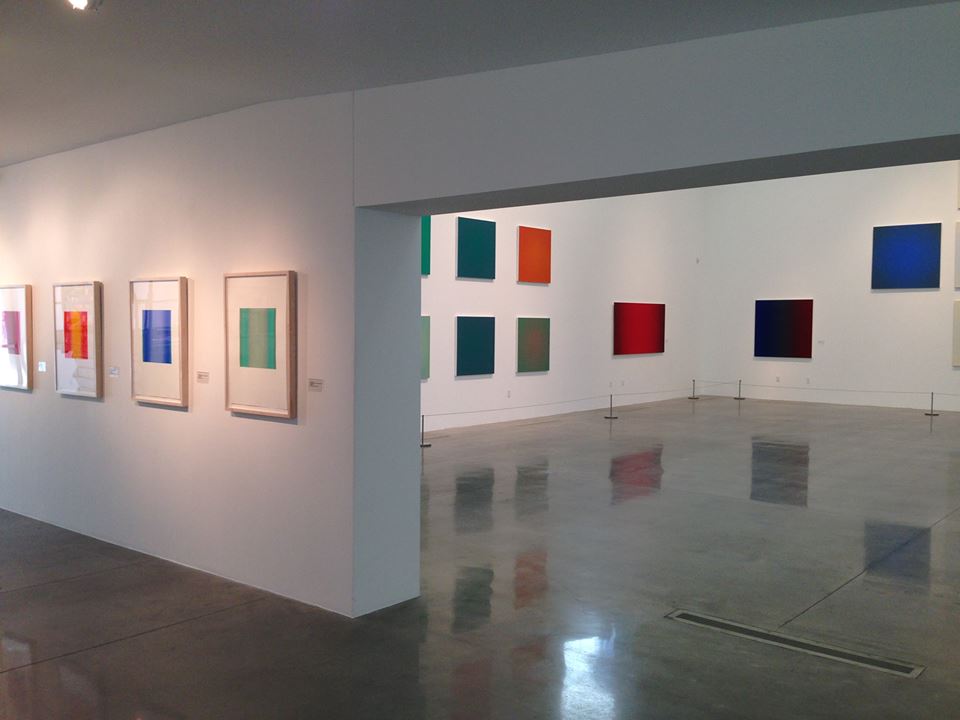
Four years ago, the Lancaster Museum of Art and History (MOAH) went through a major renovation with its groundbreaking new building alongside the hiring of Andi Campognone, noted Southern California curator and arts-professional, to manage its program. Since then, the museum’s permanent collection has been plumped up by a bevy of serious regional artists as well an exhibition schedule that continues to give a glimpse at what’s happened in California’s past, what is exciting about its present and what is evolving artistically towards its future. An example of this can be seen in the current show Colorimetry.
At its roots, Colorimetry is a luscious and lickable show about color with art that uses non-pictorial imagery and covers a range of finish fetish lines from the ethereal to the slick. Although each artist uses light and color differently, they are all paying homage to light and color in its elemental state in ways that invite the viewer deeply into an engaged space of shared devotion. This is articulated through optical illusions that feel like 3-dimensional space, projected animations, candy-like hypnotic visuals, or by completely enveloping the viewer in light and color.
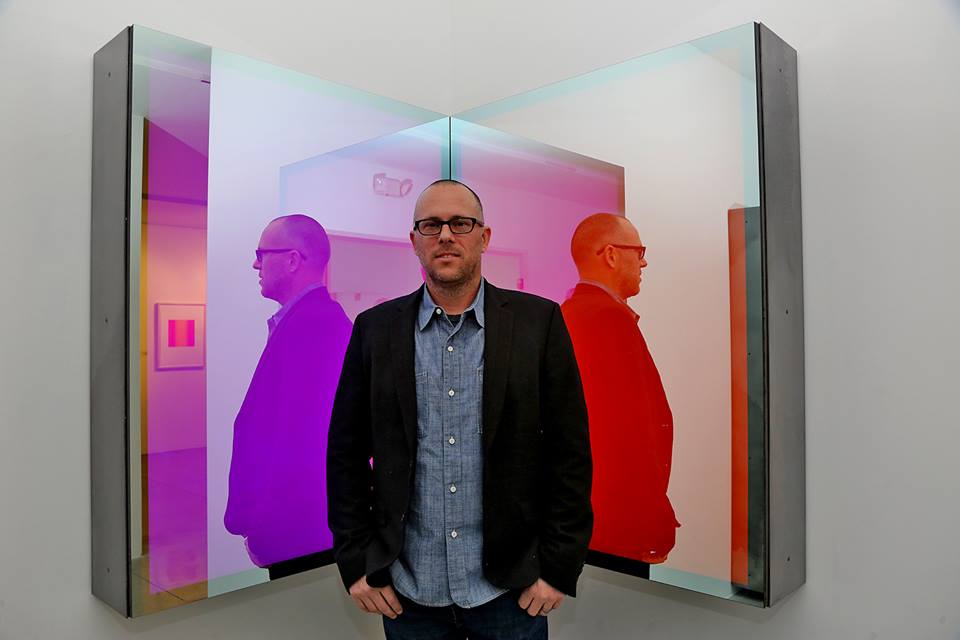
Phillip K. Smith III in front of Lucid Stead pieces, Lancaster Museum of Art and History, Lancaster
Phillip K. Smith III’s colored panels represent windowpanes that reflect and project spaces occupied by the viewer through a mirroring of both literal environment and the present color of mood, which shifts and morphs moment to moment like the sun and moon phases of a day.

Gisela Colon, Glo Pod, Colorimetry, Lancaster Museum of Art and History, Lancaster
Gisela Colon’s Glo Pods investigate the properties of light in solid form and luminescent color through the use of industrial plastic materials.

Ruth Pastine, Oil on Canvas, Colorimetry, Lancaster Museum of Art and History, Lancaster
Artist Ruth Pastine offers soft, inviting visceral experiences through oil and pastel studies which marry warm and cool colors or light and dark fields.
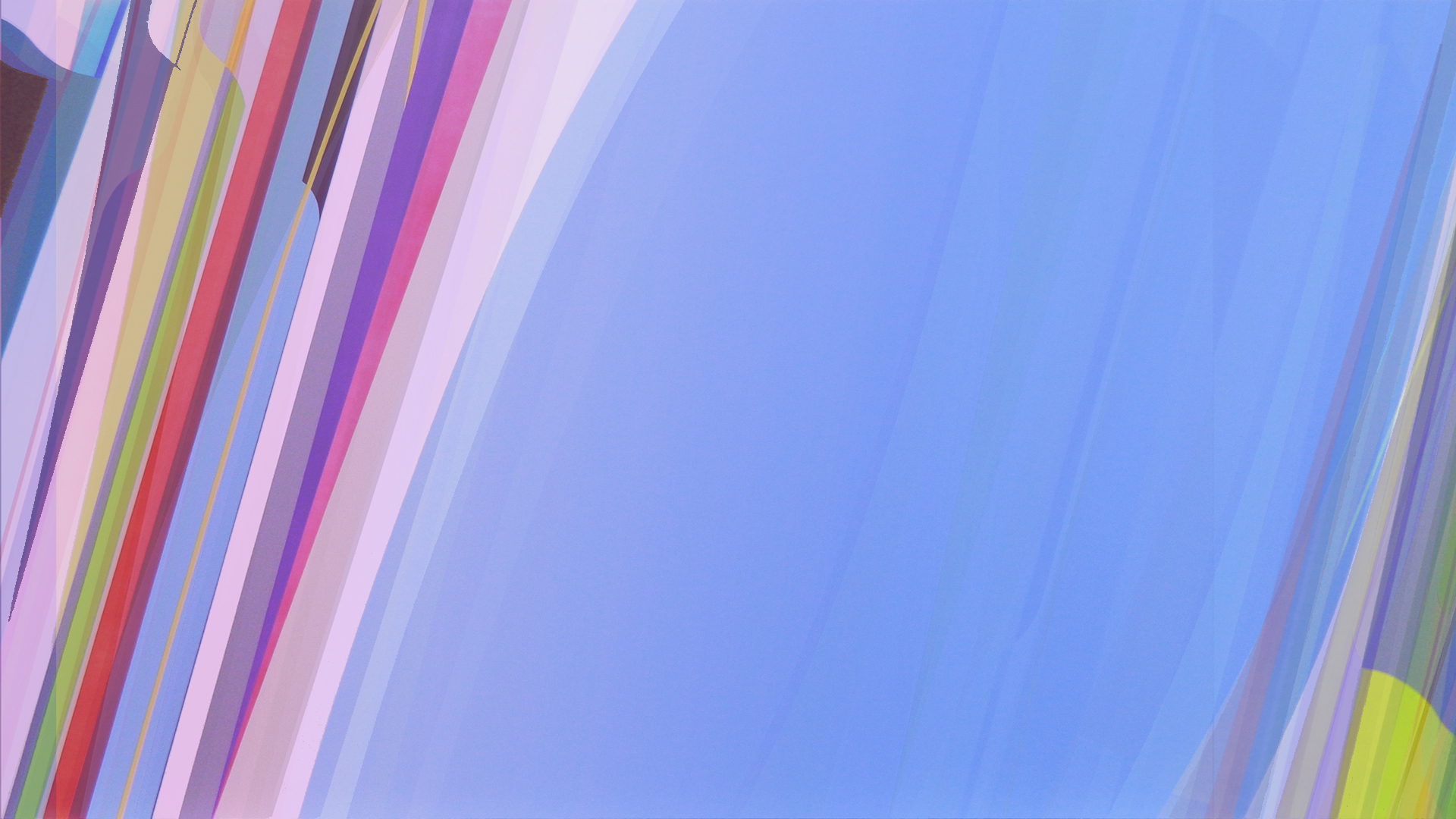
Dion Johnson, Colorimetry, Lancaster Museum of Art and History, Lancaster
Dion Johnson’s video painting is a digital collage of fluid swatches of color and form inspired by his own interaction with the ephemeral in his life: the shadows that splay across his living room wall, a freeway traversed in his day to day, or the shapes that form when light dances through architectural form.

Portrait of Girardoni in installation at MOAH 2014 image by Eric Minh Swenson
Johannes Girardoni’s installation of semi-translucent blue cast resin beams completely consumes a room in which viewers can walk around the eerie light sticks and hear the sounds that their human presence makes while engaging in the space with the work. The buzz of human energy mingling with and influencing the work’s energy denotes an otherworldly landscape yet one that is inherent and oddly familiar.

John Eden, Vietnam, Colorimetry, Lancaster Museum of Art and History, Lancaster
Sculptor John Eden presents multicolored disks that are interpretations of the symbols and colors used to identify military aircrafts’ country of origin. Bold, attractive, irresistible and alluring, these high polished works are “beautiful objects of lethal intent” and have much to impart about the dual cultural identity and connotations of the aerospace engineering industry.

Karl Benjamin, #8, Colorimetry, Lancaster Museum of Art and History, Lancaster
Although Karl Benjamin is noted in history for being one of the “hard edge” abstract painters of the post war era, he is included in this show for his use of color and color relationships.
It would be remiss not to mention the obvious influence of the traditional light and space artists such as Larry Bell, Robert Irwin, Helen Pashgian, James Turrell and DeWain Valentine wavering in the background of this exhibition but the show does much more than merely extrapolate and elaborate on material lust and technique mastery from a previous historical perspective. It introduces a less severe stringency towards permitting the presence of the artist’s hand into art works while also showing technological advancement and its integration into art both on a compositional and material level. Additionally, it invites a living and breathing consciousness into the experiential aspects of art of which color becomes an instigator.
COLORIMETRY, LANCASTER MUSEUM OF ART AND HISTORY, LANCASTER through MARCH 16, 2014


